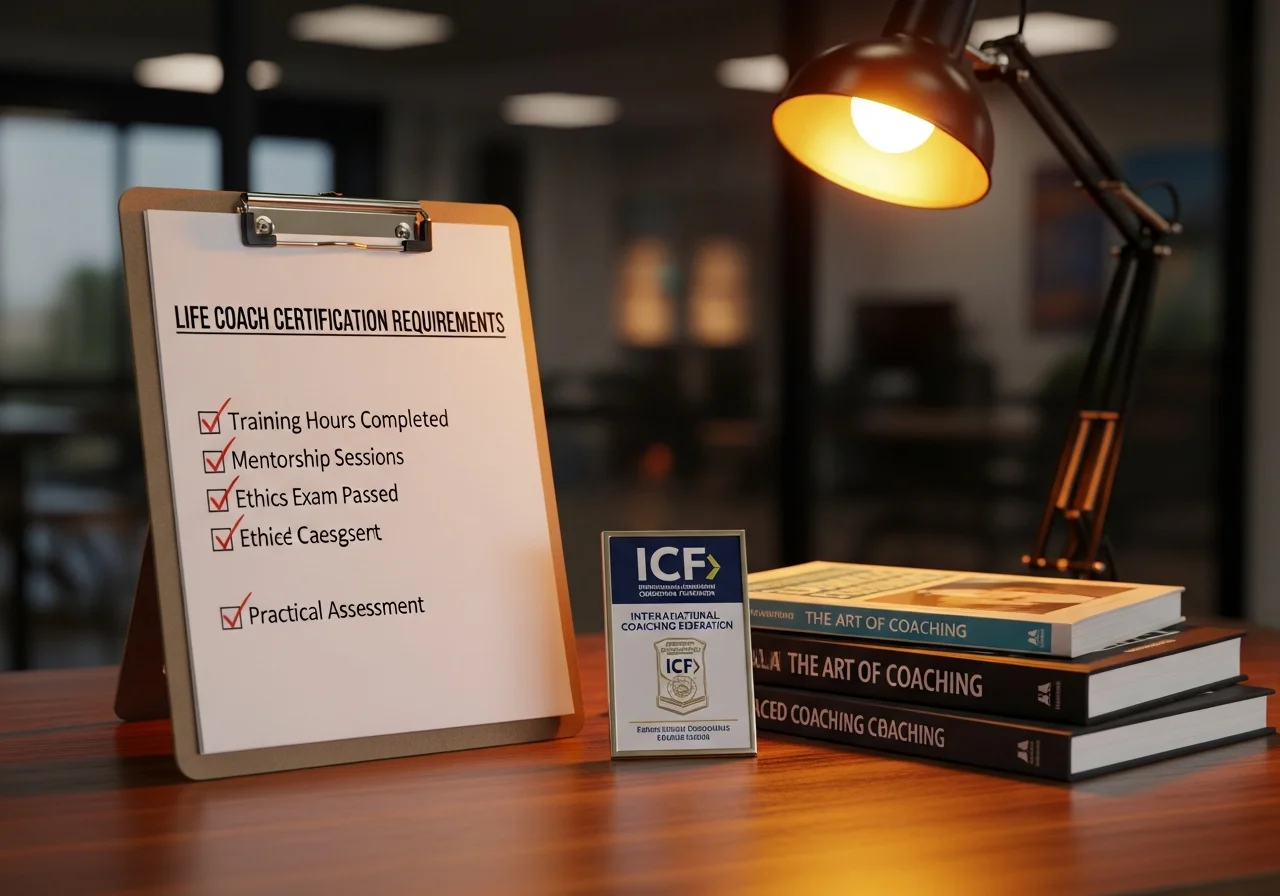
- 1.No U.S. state requires a license or certification to practice life coaching — it's a completely unregulated profession (Symbiosis Coaching, 2025; Luisa Zhou, 2026)
- 2.ICF-ACC (the most common entry credential) requires 60 training hours, 100 coaching hours, 10 mentor coaching hours, and passing the ICF ACC Credential Exam (ICF, 2025)
- 3.ICF now has 50,000+ credential-holders in 140+ countries, with 14,000 new credentials issued in the past 14 months alone (ICF, December 2025)
- 4.Three separate credentialing bodies exist — ICF, CCE, and NBHWC — each with different requirements, costs, and target markets

Professional Life Coach Certification
Foundational coaching certification covering methods, tools, and industry best practices.

Life Purpose Coach Certification
Help clients uncover purpose, align actions with values, and create meaningful lives.

Confidence Coach Certification
Help clients develop unshakable self-trust and overcome self-doubt.

NLP Coach Certification
Leverage NLP techniques to reprogram the subconscious for lasting transformation.
Affiliate link · We may earn a commission at no extra cost to you
The Truth: No Certification Is Legally Required
Let's start with the fact that surprises most people: you don't need any certification, license, or degree to call yourself a life coach in the United States. No state requires it. No federal agency regulates it. You could print business cards tomorrow and start charging clients.
According to Symbiosis Coaching's 2025 legal guide, there are "no federal or state licenses required specifically for life coaching, no government-mandated educational standards for coaching practices, and no official regulatory bodies enforcing coaching credentials." Luisa Zhou's 2026 legal requirements guide confirms the same: life coaching is an unregulated profession in the U.S.
So why do thousands of coaches invest $3,000-$20,000+ in certification? Three reasons.
Credibility with clients. The coaching industry hit $5.34 billion in global revenue in 2025, according to the ICF Global Coaching Study. As the market grows, clients are getting more discerning. An ICF credential signals that you've been trained, mentored, evaluated, and tested against a recognized standard — not just that you read a few books and hung a shingle.
Access to premium markets. Corporate clients, executive coaching contracts, and employer-sponsored coaching programs almost universally require ICF credentials. If your target market is organizations, you'll need letters after your name.
Actual competence. Good training programs don't just hand you a certificate. They teach coaching frameworks, ethical boundaries, active listening skills, and how to hold space for transformation without crossing into therapy. The coaching vs. therapy boundary matters — coaches who cross it face real legal exposure. Proper training helps you stay on the right side.
Bottom line: certification isn't legally required, but it's professionally essential for anyone who wants to build a sustainable coaching practice. Here's what each credential actually demands.
ICF-ACC: The Entry-Level Gold Standard
The ICF Associate Certified Coach (ACC) is where most coaches start — and for good reason. The International Coaching Federation is the largest and most recognized coaching credentialing body worldwide, with over 50,000 active credential-holders across 140+ countries as of December 2025.
Training: 60+ hours of coach-specific education. You'll need to complete a minimum of 60 hours from an ICF-accredited Level 1 program. These programs cover the ICF Core Competencies, the ICF Code of Ethics, and the ICF definition of coaching. Level 1 programs (formerly called ACSTH) typically offer 60-75 hours of coach-specific training.
Coaching experience: 100+ hours. At least 100 hours of coaching experience, of which a minimum of 75 hours must be paid. The remaining 25 can be pro bono. These hours must be with actual clients — not practice sessions with classmates.
Mentor coaching: 10 hours over 3+ months. You'll work with an experienced ICF-credentialed coach who observes your coaching, provides feedback, and helps you develop your skills. The 10 hours should include at least 3 hours of individual mentoring and can include up to 7 hours of group mentoring. Many training programs bundle this in; others charge $1,000-$2,000 separately.
Performance evaluation. You'll submit a recorded coaching session for assessment against the updated ACC Minimum Skills Requirements (revised January 2026). Trained assessors evaluate your coaching against the ICF Core Competencies and ACC Behavioral Statements.
ICF ACC Credential Exam. As of March 2025, the ICF introduced a dedicated ACC exam — separate from the PCC-level exam that ACC candidates previously took. It's a computer-based, multiple-choice exam administered through Pearson VUE testing centers or via online proctoring. It assesses knowledge of the ICF Core Competencies, Code of Ethics, and the ICF Definition of Coaching.
No degree required. ICF doesn't require any specific educational background. You don't need a bachelor's degree, a psychology degree, or any other formal education beyond the coaching-specific training hours.
Cost: $3,400-$7,300 total. Training programs run $3,000-$6,000, mentor coaching $0-$2,000, and the application fee is $175 for ICF members ($325 for non-members). For a full cost breakdown, see our certification cost guide.
Timeline: 6-12 months for most candidates who are actively training and coaching simultaneously.
ICF Credential Requirements: ACC vs. PCC vs. MCC
| Requirement | ICF-ACC | ICF-PCC | ICF-MCC |
|---|---|---|---|
| Training Hours | 60+ hours (Level 1) | 125+ hours (Level 2) | 200+ hours (Level 3) |
| Coaching Experience Hours | 100+ (75 paid) | 500+ (50 in last 18 months) | 2,500+ (across 35+ clients) |
| Mentor Coaching Hours | 10 hours over 3+ months | 10 hours over 3+ months | 10 hours over 3+ months (MCC-level mentor) |
| Performance Evaluation | 1 recorded session | 1 recorded session | 2 recorded sessions + transcripts |
| Exam Required | ICF ACC Exam (new 2025) | ICF Credentialing Exam | ICF Credentialing Exam |
| Degree Required | No | No | No |
| Cost Range | $3,400-$7,300 | $7,000-$16,800 | $8,000-$20,000+ |
| Timeline | 6-12 months | 2-4 years | 5-10+ years |
Source: ICF, December 2025
ICF-PCC and ICF-MCC: Advanced Credentials
Once you hold an ACC, the next steps are the Professional Certified Coach (PCC) and Master Certified Coach (MCC). Each level roughly doubles the requirements of the previous one.
ICF-PCC Requirements
PCC is the mid-career credential and the most common level for full-time professional coaches. According to the ICF's official PCC page, you'll need:
125+ hours of coach-specific education from an ICF-accredited Level 2 program (formerly ACTP). Level 2 programs build on Level 1 foundations with more advanced competency development, typically offering 125-175 hours of training.
500+ hours of coaching experience, with at least 50 of those hours completed within the 18 months before you submit your application. This recency requirement ensures you're actively coaching, not just listing old hours.
10 hours of mentor coaching over a minimum of 3 months, from an eligible PCC- or MCC-level mentor coach.
A passing score on the ICF Credentialing Exam. This is the same exam used for the PCC level — it hasn't changed like the ACC exam did. Note that PCC Minimum Skills Requirements format was updated in 2026 for consistency with the ACC and MCC updates, but the actual requirements stayed the same.
Application fee: $375 (ICF member) to $750 (member, portfolio path). Non-member fees range from $525 to $900 depending on pathway. The Level 2 path is the least expensive; the portfolio path is the most.
Realistic timeline: 2-4 years from ACC to PCC. The 500 coaching hours are the bottleneck — at 10 sessions per week, it takes about a year of consistent practice. Most coaches take 2-3 years.
ICF-MCC Requirements
MCC is the pinnacle of ICF credentialing — reserved for coaches who've demonstrated mastery over years of practice. The official MCC requirements include:
200+ hours of coach-specific education from an ICF-accredited Level 3 program or through the portfolio path.
2,500+ hours of coaching experience across a minimum of 35 different clients. The client diversity requirement ensures MCC holders have breadth of experience, not just depth with a few clients.
10 hours of mentor coaching from an MCC-level mentor coach specifically — not just any credentialed coach.
Two recorded coaching sessions plus transcripts submitted for performance evaluation against the MCC Minimum Skills Requirements. This is stricter than ACC and PCC, which only require one session.
You must hold (or have held) a PCC credential. You can't skip from ACC to MCC.
Application fee: $675 for ICF members, $825 for non-members.
Realistic timeline: 5-10+ years from starting your coaching career. The 2,500 hours alone take 3-5 years of full-time coaching to accumulate. MCC holders tend to be veteran coaches who've been in practice for a decade or more.
Other Credentials: CCE-BCC and NBHWC
ICF isn't the only game in town. Two other credentialing bodies serve specific coaching niches — and their requirements differ significantly.
CCE Board Certified Coach (BCC)
The Board Certified Coach credential is issued by the Center for Credentialing & Education (CCE), an affiliate of the National Board for Certified Counselors (NBCC). It's designed for professionals with existing graduate-level education in counseling, psychology, social work, education, or related behavioral sciences.
Education requirements vary by background. According to the official BCC requirements page, candidates with a master's or doctorate in counseling need 30 hours of coach-specific training from a CCE Approved Provider. Those with a master's in social work need 60 hours. Candidates with a bachelor's degree (any field) need a minimum of 2,500 hours of coaching experience over at least 5 years, plus coach-specific training.
Coaching experience: 30+ hours minimum of post-degree coaching services, verified by a professional coach, colleague, or supervisor.
Exam: The Board Certified Coach Examination (BCCE) is available at computer-based testing centers worldwide or via online proctoring.
Cost: Application and exam fee is $279 ($229 for National Certified Counselors). Recertification is required every 5 years and requires 70 continuing education hours, including 4 hours in coaching ethics.
Best for: Counselors, therapists, social workers, and psychologists who want to add coaching to their practice. The degree requirement makes it less accessible than ICF for career changers, but the lower training hours and exam-only cost make it affordable for those who qualify.
National Board Certified Health & Wellness Coach (NBC-HWC)
The NBHWC credential is specifically for health and wellness coaching — not general life coaching. It's the most clinically-oriented of the three and is increasingly recognized by healthcare systems and insurance companies.
Education: Associate degree or higher (any field), or 4,000 hours of work experience in any field. The education requirement is more flexible than BCC — it doesn't need to be in a health-related discipline.
Training: NBHWC-approved program completion required. These programs must meet NBHWC standards for content, contact hours, and practical skills assessment. Most programs run 48-100+ live training hours plus asynchronous coursework. Costs range from about $2,500 to $5,000+ depending on the provider.
Practical experience: 50 coaching sessions minimum, each at least 20 minutes long. At least 75% of sessions must focus on coaching (not education or instruction), and sessions can be paid or pro bono — but not with friends, family, or classmates.
Exam: The Health & Wellness Coach Certifying Examination is administered by the NBME (the same organization that administers medical board exams). It includes 150 multiple-choice questions with a 4.5-hour testing window, offered at specific dates and approved testing locations.
Cost: Application fee is $100 (nonrefundable) plus an exam fee of $400, for a total of $500. Retakes cost $500 each, and you're allowed up to 3 retakes before additional training is required. Recertification is every 3 years.
Best for: Coaches focused on health behavior change, chronic disease management, wellness, and fitness. If your coaching niche involves physical health outcomes, NBHWC is more relevant than ICF. See our guide to health and wellness coaching for more on this path.
ICF-ACC vs. CCE-BCC vs. NBHWC: Which Credential Fits?
| Factor | ICF-ACC | CCE-BCC | NBHWC |
|---|---|---|---|
| Credentialing Body | International Coaching Federation | Center for Credentialing & Education | National Board for Health & Wellness Coaching |
| Degree Required | No | Yes (bachelor's minimum, master's preferred) | Associate degree or 4,000 work hours |
| Training Hours | 60+ hours (ICF-accredited) | 30-60 hours (CCE-approved) | 48-100+ hours (NBHWC-approved) |
| Coaching Experience | 100+ hours (75 paid) | 30+ hours (post-degree) | 50 sessions (20+ min each) |
| Exam | ICF ACC Exam (Pearson VUE) | BCCE (computer-based or online) | HWCCE (NBME, 150 questions, 4.5 hrs) |
| Application + Exam Cost | $175-$325 | $229-$279 | $500 ($100 app + $400 exam) |
| Renewal Cycle | Every 3 years | Every 5 years | Every 3 years |
| Best For | General life/executive coaching | Counselors adding coaching skills | Health & wellness coaching |
Traditional ICF Programs
- Cost: $3,000–$15,000
- Duration: 6–12 months
- Schedule: Fixed class times
- Location: In-person or scheduled live
Transformation Academy
- Cost: $197
- Duration: Self-paced
- Schedule: Start anytime
- Location: 100% online
Affiliate link · We may earn a commission at no extra cost to you
State Regulations: What the Law Actually Says
Spoiler: no U.S. state requires a license to practice life coaching. But there are important nuances.
As of 2026, according to Luisa Zhou's legal guide and Paperbell's 2025 compliance overview, there are no state-issued coaching licenses, no government-mandated educational standards for coaching, and no official regulatory bodies overseeing the coaching profession.
But there are boundary lines. Life coaches cannot diagnose, treat, or claim to heal mental health conditions — that requires licensure as a therapist, counselor, social worker, or psychologist (LPC, LCSW, PsyD, etc.). Crossing that boundary isn't just unethical; it can result in legal action for practicing therapy without a license. If a client presents with clinical depression, PTSD, anxiety disorders, or other diagnosable conditions, the ethical move is to refer them to a licensed mental health professional. For a clear breakdown of where coaching ends and therapy begins, see our guide on life coaching vs. therapy.
Niche-specific regulations apply. According to Cohen Healthcare Law, coaches who venture into adjacent areas may need additional credentials. Nutrition coaching, for example, is regulated in many states — you may need a registered dietitian (RD) or licensed nutritionist credential to give specific dietary advice. Financial coaching may trigger financial advisor regulations. Health coaching that involves medical advice may overlap with healthcare licensing.
Business requirements are separate from coaching requirements. You'll likely need a general business license, and depending on your locality, you may need a home occupation permit (if coaching from home), sales tax registration (if selling products or courses), and professional liability insurance (strongly recommended though not legally required in most states). See our guide on starting a coaching business for the practical checklist.
The bottom line on regulation: The coaching industry self-regulates through voluntary credentialing bodies like ICF, CCE, and NBHWC. While this means lower barriers to entry, it also means your credential is your differentiation. In an unregulated market, clients and employers use certifications as a proxy for competence. For a deeper look at all requirements for becoming a life coach — including business, legal, and skills requirements — see our full guide.
50,000+
ICF Credential-Holders
Active worldwide, 140+ countries (ICF, Dec 2025)
$5.34B
Coaching Industry Revenue
Global, 2025 ICF Global Coaching Study
122,974
Coach Practitioners
Worldwide, up 15% from 2023 (ICF, 2025)
How to Choose the Right Credential
With three credentialing bodies and multiple levels, picking the right certification path can feel overwhelming. Here's how to cut through the noise.
Start with your target market. Who are you coaching, and what do they expect? Corporate clients and HR departments almost always require ICF credentials. Healthcare systems increasingly recognize NBHWC. Licensed counselors adding coaching to their practice fit naturally with CCE-BCC.
Consider your existing background. If you already hold a master's in counseling or psychology, BCC requires only 30 hours of additional coach-specific training — far less than ICF-ACC's 60 hours plus 100 coaching experience hours. If you have a health sciences background, NBHWC may align better with your existing knowledge and client base.
Think about long-term trajectory. ICF has the clearest progression path: ACC to PCC to MCC. Each level increases your credibility and earning potential. BCC and NBHWC are standalone credentials without a similar tiered advancement. If you see yourself advancing in the coaching profession over a decade, the ICF pathway gives you the most room to grow.
Factor in global recognition. ICF is the most widely recognized credential internationally. If you plan to coach clients across borders or build an online coaching practice, ICF credentials travel better than BCC or NBHWC.
Don't overlook program accreditation. Whatever credential you choose, make sure your training program is approved by the relevant body. ICF-accredited programs are listed in the ICF Education Search Service. CCE-approved providers are listed on the CCE website. NBHWC-approved programs are at nbhwc.org. Spending money on a non-accredited program means you'll need to redo your training or take a more expensive application path.
Which Should You Choose?
- You want the industry's most recognized and portable credential
- Your target market includes corporate clients, executive coaching, or employer-sponsored programs
- You plan to advance to PCC or MCC over time
- You don't have a graduate degree in counseling or health sciences
- You already hold a master's or doctorate in counseling, psychology, social work, or education
- You want to add coaching skills to an existing therapy or counseling practice
- You prefer lower training hour requirements (30-60 hours vs. 60+)
- You value a credential connected to the NBCC counseling ecosystem
- Your coaching niche is health, wellness, fitness, or chronic disease management
- You want a credential recognized by healthcare systems and insurance companies
- You have a health sciences or clinical background
- You're focused on behavior change related to physical health outcomes
- You're exploring coaching as a career and want to test the waters first
- Your budget doesn't allow $3,000+ right now and you want to start earning first
- You're coaching in an informal context (mentoring friends, pro bono work)
- You plan to pursue certification later using client revenue to fund it
Your Certification Roadmap
Choose Your Credentialing Body
Decide between ICF (broadest recognition), CCE-BCC (best for counseling/psychology backgrounds), or NBHWC (best for health/wellness focus). Most aspiring coaches should start with ICF-ACC unless they have a specific reason to go another route.
Find an Accredited Training Program
Search the ICF Education Search Service, CCE Approved Provider list, or NBHWC approved program directory. Verify accreditation before enrolling — non-accredited programs mean extra steps and costs when you apply for your credential.
Complete Your Training and Start Coaching
Finish the required training hours (60+ for ICF-ACC, 30-60 for BCC, 48-100+ for NBHWC). Start accumulating coaching experience hours simultaneously. Offer pro bono sessions to build hours faster while developing your skills.
Get Mentor Coaching and Record Sessions
For ICF: complete 10 hours of mentor coaching over 3+ months and record at least one coaching session for your performance evaluation. For NBHWC: log 50 coaching sessions with proper documentation. For BCC: get your 30+ coaching hours verified by a professional colleague.
Apply and Pass the Exam
Submit your application with all documentation, pay the application fee, and schedule your exam through Pearson VUE (ICF), the CCE testing system (BCC), or NBME (NBHWC). If you fail, you can retake: ICF charges $105 per retake, NBHWC charges $500. Then start coaching with your new credential — and plan for renewal requirements.
Frequently Asked Questions
Sources
Official ACC requirements: 60+ training hours, 100+ coaching hours, 10 mentor coaching hours, performance evaluation, ACC exam
Official PCC requirements: 125+ training hours, 500+ coaching hours, credentialing exam, 10 mentor coaching hours
Official MCC requirements: 200+ training hours, 2,500+ coaching hours across 35+ clients, 2 recorded sessions, MCC-level mentor
ACC $175/$325, PCC $375-$750/$525-$900, MCC $675/$825 (member/non-member)
50,000+ active credential-holders worldwide, 14,000 new in past 14 months, 400% increase over the past decade
122,974 coach practitioners worldwide (up 15%), $5.34B industry revenue, 72% female profession
Revised MSRs effective January 1, 2026 for ACC and MCC; PCC requirements unchanged
ACC: 100+ hours (75 paid), PCC: 500+ hours (50 within 18 months), MCC: 2,500+ hours (35+ clients)
ICF exam administration through Pearson VUE global testing centers and OnVUE remote proctoring
New ACC exam (introduced March 2025): shorter than PCC exam, multiple-choice, covers core competencies and ethics
BCC eligibility: master's/doctorate preferred, 30-60 coach-specific training hours, 30+ hours coaching experience
Application and exam fee $279 ($229 for NCCs), 5-year renewal, 70 CE hours per cycle
NBC-HWC requirements: NBHWC-approved program, 50 coaching sessions, associate degree or 4,000 work hours
150 multiple-choice questions, 4.5-hour testing window, $400 exam fee + $100 application fee
No federal or state licenses required, no government-mandated educational standards, no regulatory bodies
Life coaching is unregulated in the U.S., but boundary lines exist with therapy, nutrition, and financial advising
Niche-specific regulations for nutrition coaching, health coaching, and wellness services across states
ACC total cost $3,400-$7,300, training = 85-90% of total, retake fee $105
Find the Right Certification Program
Compare coaching certifications side-by-side — ICF, BCC, NBHWC, and affordable alternatives — to find the path that matches your goals and budget.
Latest Articles

Life Coaching Industry Trends 2026
The coaching industry hit $5.34 billion. Here are the trends shaping 2026 and what they mean for new coaches.

How Much Does Certification Cost?
Complete cost breakdown: ICF-ACC, ICF-PCC, affordable alternatives from $197, and hidden costs nobody mentions.

Can ChatGPT Replace a Life Coach?
AI chatbots vs human coaches: effectiveness, cost, and what the research actually says.
Taylor Rupe
B.A. Psychology | Editor & Researcher
Taylor holds a B.A. in Psychology, giving him a strong foundation in human behavior, motivation, and the science behind personal development. He applies this background to evaluate coaching methodologies, certification standards, and career outcomes — ensuring every article on this site is grounded in evidence rather than industry hype.