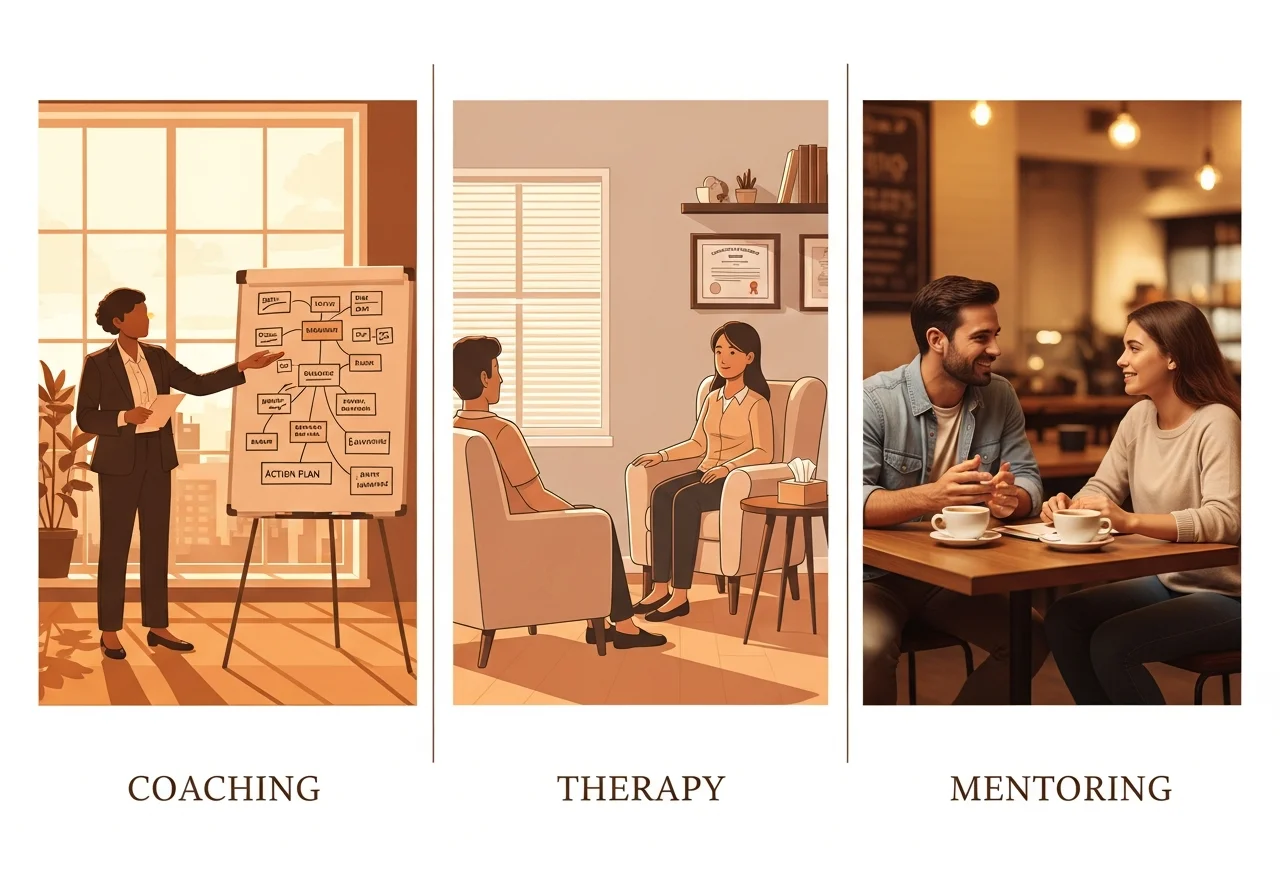
- 1.Coaching is future-focused and goal-oriented — the ICF defines it as "partnering with clients in a thought-provoking and creative process that inspires them to maximize their personal and professional potential" (ICF, 2025)
- 2.Therapy is a licensed healthcare profession that diagnoses and treats mental health conditions — it requires a master's or doctoral degree and state licensure (APA)
- 3.Mentoring is experience-based and advisory — a mentor shares knowledge from their own career or life, often informally and without a formal fee structure
- 4.You can use more than one at the same time, and many people benefit from combining coaching with therapy or mentoring depending on their needs

Professional Life Coach Certification
Foundational coaching certification covering methods, tools, and industry best practices.

Life Purpose Coach Certification
Help clients uncover purpose, align actions with values, and create meaningful lives.

Confidence Coach Certification
Help clients develop unshakable self-trust and overcome self-doubt.

NLP Coach Certification
Leverage NLP techniques to reprogram the subconscious for lasting transformation.
Affiliate link · We may earn a commission at no extra cost to you
Why People Confuse Coaching, Therapy, and Mentoring
All three involve one person helping another through conversation. That's where most of the confusion starts — and, for most people, where the similarities end.
Coaching, therapy, and mentoring differ in purpose, training, regulation, cost, and the type of relationship involved. Misunderstanding these boundaries creates real problems. Clients hire coaches when they need therapists. People seek mentors when they'd benefit from structured coaching. And aspiring practitioners choose a career path without understanding what each one actually entails.
The coaching industry alone generates $5.34 billion in annual revenue and employs over 122,000 practitioners worldwide, according to the 2025 ICF Global Coaching Study. Therapy is a much larger field — the APA estimates over 106,000 licensed psychologists practice in the U.S. alone. Mentoring is harder to quantify because it's often informal and unpaid.
This guide breaks down each profession with verified data — what they do, what they cost, what training they require, and when each one is the right fit. If you're weighing these options as a potential client or considering which path to pursue professionally, this is your starting point.
Life Coaching vs Therapy vs Mentoring: Side-by-Side Comparison
| Factor | Life Coaching | Therapy/Counseling | Mentoring |
|---|---|---|---|
| Focus / Orientation | Future goals, growth, and action plans | Past experiences, mental health, healing | Career/life experience transfer and guidance |
| Practitioner Title | Life coach, certified coach (ACC, PCC, MCC) | Licensed therapist, psychologist, counselor (LCSW, LPC, LMFT) | Mentor (no standardized title) |
| Education Required | Coach training program (60+ hours for ICF-ACC) | Master's or doctoral degree + 2,000-4,000 supervised clinical hours | None formal — based on personal/professional experience |
| Regulation | Unregulated in most states; ICF sets voluntary standards | State licensing boards (mandatory); HIPAA applies | No regulation — informal or organizational |
| Typical Cost per Session | $75-$300+ (rarely insurance-covered) | $100-$250+ (often insurance-covered) | Usually free; some formal programs charge fees |
| Session Format | Structured sessions (45-60 min), often via video or phone | Clinical sessions (45-60 min), in-person or telehealth | Informal meetings, coffee chats, or scheduled calls |
| Typical Duration | 3-12 months (goal-dependent) | Months to years (condition-dependent) | Ongoing — often years or career-long |
| Relationship Dynamic | Partnership — the client is the expert on their own life | Clinical — the therapist brings diagnostic expertise | Advisory — the mentor shares experience and guidance |
| Primary Goal | Achieve specific goals, build accountability, unlock potential | Diagnose and treat mental health conditions, process trauma | Transfer knowledge, accelerate career growth, provide wisdom |
| Best For | People who are functioning well and want to level up | People dealing with clinical mental health issues | People seeking industry expertise or career direction |
What Life Coaching Actually Is
The International Coaching Federation (ICF) defines coaching as "partnering with clients in a thought-provoking and creative process that inspires them to maximize their personal and professional potential." That definition is worth unpacking.
Notice the word "partnering." A coach doesn't tell you what to do. They don't diagnose what's wrong with you. They work alongside you to help you clarify what you want, identify what's in the way, and build a plan to get there. The underlying assumption is that the client is the expert on their own life — the coach's job is to ask the right questions, challenge assumptions, and provide accountability.
Coaching is forward-focused. While a therapist might spend sessions exploring why you have a particular pattern, a coach asks: "What do you want instead, and what's your first step?" This doesn't mean coaches ignore the past entirely — but the past is only relevant to the extent that it informs future action.
Coaching works with generally healthy people. Clients come to coaching because they want to perform better, not because they're in crisis. Common coaching goals include career transitions, starting a business, improving relationships, developing leadership skills, and building healthier habits. If a client is dealing with clinical depression, anxiety disorders, or trauma, that's a therapist's domain — not a coach's.
The coaching industry has grown rapidly. According to the 2025 ICF Global Coaching Study (conducted by PwC), the global number of coach practitioners rose 15% since 2023 to 122,974 worldwide. In the U.S., active coaches earn an average of $71,719 annually. The average global coaching fee is $234 per hour.
Training for coaches is substantially shorter than for therapists. The entry-level ICF-ACC credential requires 60+ hours of coach-specific training, 100+ hours of coaching experience, and 10 hours of mentor coaching — achievable in 6-12 months. For a complete breakdown, see our life coach requirements guide.
What Therapy Is (And Why the Distinction Matters)
The American Psychological Association (APA) defines psychotherapy as "the informed and intentional application of clinical methods and interpersonal stances derived from established psychological principles for the purpose of assisting people to modify their behaviors, cognitions, emotions, and/or other personal characteristics in directions that the participants deem desirable."
In plain language: therapy is a clinical healthcare service. Therapists diagnose and treat mental health conditions — depression, anxiety, PTSD, addiction, personality disorders, eating disorders, and more. They're trained to work with complex psychological presentations that coaching isn't designed to address.
Therapy is heavily regulated. Every state requires therapists to hold a license (LCSW, LPC, LMFT, or a psychology doctorate). Getting that license requires a master's or doctoral degree (2-7+ years of graduate education), 2,000-4,000 hours of supervised clinical experience, and passing state licensing exams. Total time from starting graduate school to independent practice: 4-6 years minimum.
The cost of becoming a therapist reflects this. A master's in counseling or social work runs $40,000-$120,000+ depending on the program, according to data from From Degree To Practice. Private university and doctoral programs can push total costs above $200,000.
For clients, therapy typically costs $100-$250 per session without insurance, according to Project Healthy Minds. A key difference from coaching: therapy is frequently covered by health insurance, and many therapists accept insurance plans. Coaching almost never is.
The legal boundary matters. As CPH Insurance notes, coaching services must avoid diagnostic or therapeutic language associated with mental health treatment to stay on the right side of licensing laws. A coach who crosses into clinical territory — even unintentionally — risks legal consequences and, more importantly, client harm. For a detailed breakdown of this boundary, see our coaching vs therapy comparison.
What Mentoring Is (And Why It's Different From Both)
Mentoring is the oldest of the three practices and the least formalized. A mentor shares knowledge, experience, and guidance from their own career or life path. Unlike coaching, mentoring is advice-driven — the mentor's personal experience is the primary value they bring.
As the UK Life Coach Training Centre explains, mentoring involves a transfer of knowledge and skill from outside, while coaching involves growth and development from within. A coach asks you questions to help you find your own answers. A mentor tells you what worked for them and what they'd do differently.
Mentoring doesn't require any formal training or certification. There's no licensing, no regulatory body, and no standardized credential. What makes someone a good mentor is experience in the area where the mentee needs guidance — not a certificate.
Mentoring is often free. Many mentoring relationships form organically in professional settings, through alumni networks, or via programs like SCORE (for entrepreneurs) or corporate mentorship programs. Some formal mentoring services charge fees, but the norm is volunteer-based or employer-sponsored.
The time orientation also differs. According to the Coach Training Alliance, coaches focus on helping individuals reach specific, short-term goals, while mentors offer broader advice over a longer period. A coaching engagement might last 3-6 months. A mentoring relationship can span years or even an entire career.
One more distinction: mentors usually operate in a specific domain. A marketing executive mentors someone in marketing. A startup founder mentors aspiring entrepreneurs. Coaches, by contrast, apply coaching techniques across domains — they don't need to have experience in your field to help you achieve your goals.

So, You Wanna Be a Coach? Minicourse
Free intro course covering why coaching works and how to get started.
Affiliate link · We may earn a commission
Where Coaching, Therapy, and Mentoring Overlap (And Where They Don't)
These three practices aren't perfectly siloed. In real life, the boundaries can feel blurry — which is exactly why understanding them matters.
Where they overlap: All three involve structured conversations aimed at helping someone improve their life. All three require active listening, empathy, and the ability to build trust. A therapist uses open-ended questions — and so does a coach. A mentor gives encouragement — and so does a therapist.
Where they diverge: The key question is "who is the expert?" In coaching, the client is the expert — the coach facilitates discovery. In therapy, the therapist brings clinical expertise for diagnosis and treatment. In mentoring, the mentor is the expert and the mentee learns from their experience.
Common overlaps that cause confusion:
- Coaching and therapy: Both address behavior change and emotional patterns. The line is clinical diagnosis — coaches work with healthy individuals wanting growth; therapists work with mental health conditions. As discussed in our coaching vs therapy guide, a good coach knows when to refer out.
- Coaching and mentoring: Both support goal achievement. The difference is method — coaches use structured frameworks and questions; mentors share direct advice from experience. A coach doesn't need domain expertise; a mentor's value depends on it.
- Therapy and mentoring: Both can involve long-term relationships. But therapy is clinical and confidential (HIPAA-protected); mentoring is informal and based on voluntary knowledge-sharing.
One practice doesn't replace another. A mentor can't treat your anxiety. A coach can't replace your therapist. And a therapist typically won't give you specific career advice the way a mentor would. Each serves a different purpose — and combining them is often the most effective approach.
Which Should You Choose?
- You have specific goals (career change, business launch, habit building) and want structured accountability
- You're functioning well overall but feel stuck, unfocused, or ready for a transition
- You want to improve performance, clarify direction, or make a major life decision
- You need someone to challenge your thinking and hold you to your commitments
- You're willing to invest $75-$300+ per session (typically not insurance-covered)
- You're experiencing symptoms of depression, anxiety, PTSD, addiction, or another mental health condition
- Past trauma is affecting your current relationships, work, or daily functioning
- You've had persistent emotional pain that doesn't resolve on its own
- You need professional help with a diagnosable condition — not just 'feeling stressed'
- You want insurance coverage for your sessions ($100-$250+ per session, often partially covered)
- You want guidance from someone who's walked the path you're on — especially in a specific career or industry
- You're early in your career and need someone to help you navigate professional decisions
- You value advice, introductions, and 'been there, done that' wisdom over structured methodology
- You prefer an informal, long-term relationship rather than structured sessions
- Budget is a constraint — most mentoring relationships are free or low-cost
Can You Use More Than One at the Same Time?
Yes, and it's more common than you'd think. Many people work with a therapist and a coach simultaneously — or combine coaching with a mentoring relationship. The key is that each serves a distinct purpose.
As therapist and coach Imogen Roy explains, when using multiple approaches, order of operations matters. If you have unresolved trauma or active mental health symptoms, start with therapy. Coaching works best once you have a stable emotional foundation — trying to set goals and build accountability when you're in clinical distress usually doesn't work.
A practical example: Someone might work with a therapist to process grief from a job loss, a coach to plan their next career move and build accountability around job searching, and a mentor in their target industry to make connections and learn what hiring managers look for.
The professionals themselves often collaborate. Many coaches build referral networks of therapists they trust for exactly these situations. And many therapists refer stable clients to coaches when the work shifts from healing to growth. What matters is that each practitioner stays in their lane — a coach should never attempt to treat clinical issues, regardless of how many other services the client is using.
For Aspiring Practitioners: Which Path Is Right for You?
If you're reading this as someone considering a career in coaching, therapy, or mentoring, the decision comes down to who you want to serve, how much training you're willing to invest, and what kind of work energizes you.
Become a life coach if: You want to help driven, healthy people achieve specific goals. You prefer future-focused, action-oriented conversations. You want a relatively fast path to practice (6-12 months for ICF-ACC, per ICF). You value entrepreneurial flexibility — most coaches run their own practice. See our full guide to becoming a life coach.
Become a therapist if: You want to work with clinical populations and help people heal from mental health conditions. You're willing to invest 4-6+ years in graduate education and supervised practice. You want the stability of insurance reimbursement and the credibility of state licensure. You're drawn to deep psychological exploration rather than goal-setting.
Become a mentor if: You have significant domain expertise and want to give back. You prefer informal, relationship-based guidance over structured sessions. You're not looking for a primary career change — mentoring is typically an add-on to an established career, not a standalone profession.
It's worth noting that many practitioners cross paths. Licensed therapists commonly add coaching to their practice. Experienced coaches become mentors to newer coaches. And some people pursue both coaching certification and a counseling degree. The table below compares the two most common professional paths.
Become a Coach
Flexible, lower barrier to entry
Become a Therapist
Clinical, higher barrier to entry
Frequently Asked Questions
Sources
Global coaching industry revenue ($5.34B), 122,974 practitioners worldwide, U.S. average income ($71,719), average global fee ($234/hour)
Official ICF definition: partnering with clients in a thought-provoking and creative process that inspires them to maximize their personal and professional potential
American Psychological Association definition of psychotherapy and its clinical scope
Training hour requirements (60+ ACC, 125+ PCC, 200+ MCC), coaching experience minimums, and exam details
Average therapy session costs ($100-$250 without insurance), factors affecting pricing
Graduate program costs ($40,000-$200,000+), total investment timelines for therapist career paths
Differences between coaching and mentoring: goal orientation, time focus, domain expertise
Legal considerations for practitioners, avoiding diagnostic language, licensing law compliance
Mentoring as knowledge transfer from outside vs. coaching as growth from within
Order of operations for combining services, when to prioritize therapy before coaching
Ready to Start Your Coaching Career?
If you've decided coaching is the right path, your next step is understanding the requirements — training, certification, and what it takes to build a practice.
Latest Articles

Life Coaching Industry Trends 2026
The coaching industry hit $5.34 billion. Here are the trends shaping 2026 and what they mean for new coaches.

How Much Does Certification Cost?
Complete cost breakdown: ICF-ACC, ICF-PCC, affordable alternatives from $197, and hidden costs nobody mentions.

Can ChatGPT Replace a Life Coach?
AI chatbots vs human coaches: effectiveness, cost, and what the research actually says.

Taylor Rupe
B.A. Psychology | Editor & Researcher
Taylor holds a B.A. in Psychology, giving him a strong foundation in human behavior, motivation, and the science behind personal development. He applies this background to evaluate coaching methodologies, certification standards, and career outcomes — ensuring every article on this site is grounded in evidence rather than industry hype.