- 1.Over 60% of coaching sessions are now conducted via Zoom or other video platforms, making home-based coaching the industry norm (ICF 2025 Global Coaching Study)
- 2.Total startup costs for a home-based coaching business range from $1,500 to $6,000, depending on certification level and tech setup
- 3.The average LLC filing fee across all 50 states is $132, with annual fees averaging $91 (LLC University, 2026)
- 4.Self-employed coaches can deduct $5 per square foot of home office space (up to 300 sq ft) using the IRS simplified method

Professional Life Coach Certification
Foundational coaching certification covering methods, tools, and industry best practices.

Life Purpose Coach Certification
Help clients uncover purpose, align actions with values, and create meaningful lives.

Confidence Coach Certification
Help clients develop unshakable self-trust and overcome self-doubt.

NLP Coach Certification
Leverage NLP techniques to reprogram the subconscious for lasting transformation.
Affiliate link · We may earn a commission at no extra cost to you
Why Life Coaching Works Perfectly From Home
Life coaching is one of the few professions where working from home isn't a compromise — it's the standard. The 2025 ICF Global Coaching Study found that over 60% of coaching sessions happen via Zoom or other video tools, and 72% of clients prefer remote or hybrid coaching. Virtual sessions are up 40% since 2020.
This shift isn't slowing down. Virtual coaching platforms are growing at a 13.8% annual rate, and the online coaching market is projected to reach $4.5 billion by 2028 (Entrepreneurs HQ, 2026). If you're considering coaching as a career, there's never been a better time to build a practice from home.
The advantages are real: zero commute and no office lease (commercial office space averages $23-$60/sq ft annually). A global client base — 72% of coaches now serve clients outside their home country (ICF 2025). Lower overhead that lets you keep more of what you earn. And schedule flexibility that makes it easier to build your practice around family or other commitments.
The coaching industry is growing rapidly. ICF reports $5.34 billion in global revenue in 2025, nearly double the $2.849 billion in 2023. In the U.S. alone, 232,000+ coaches serve clients in a $16 billion domestic market (ResearchAndMarkets, 2025). Starting from home lets you enter this market with minimal financial risk.
For a broader overview of launching a coaching business, see our full guide to starting a coaching business.
60%+
Coaches Working Virtually
ICF 2025 Global Coaching Study
$1,500-$6,000
Avg. Home Startup Cost
Certification + LLC + tools
30-90 days
Time to First Client
With active outreach and networking
8 Steps to Launch Your Home Coaching Practice
1. Get Certified
A credential isn't legally required, but it's practically essential. Clients and referral partners take certified coaches more seriously. The ICF-ACC (Associate Certified Coach) requires 60+ hours of training and costs $3,845-$16,345 total depending on your program (Tandem Coaching, 2026). Budget options with ICF-accredited online programs start around $3,500 for training alone. See our full certifications guide to compare options.
2. Choose Your Niche
Generic "life coaching" is nearly impossible to market. The ICF reports that 54% of coaches specialize in leadership/executive coaching because corporate clients pay premium rates. Other profitable niches include business coaching, career coaching, and health & wellness coaching. Pick a niche that combines your background, your passion, and market demand.
3. Form an LLC
An LLC separates your personal assets from business liabilities — essential protection for coaches. Filing costs range from $35 (Montana) to $500 (Massachusetts), with the national average at $132 (LLC University, 2026). Annual renewal fees average $91. Four states (Arizona, Missouri, New Mexico, Ohio) charge no annual LLC fee. You'll also want a free EIN from IRS.gov and a separate business bank account.
4. Set Up Your Home Office
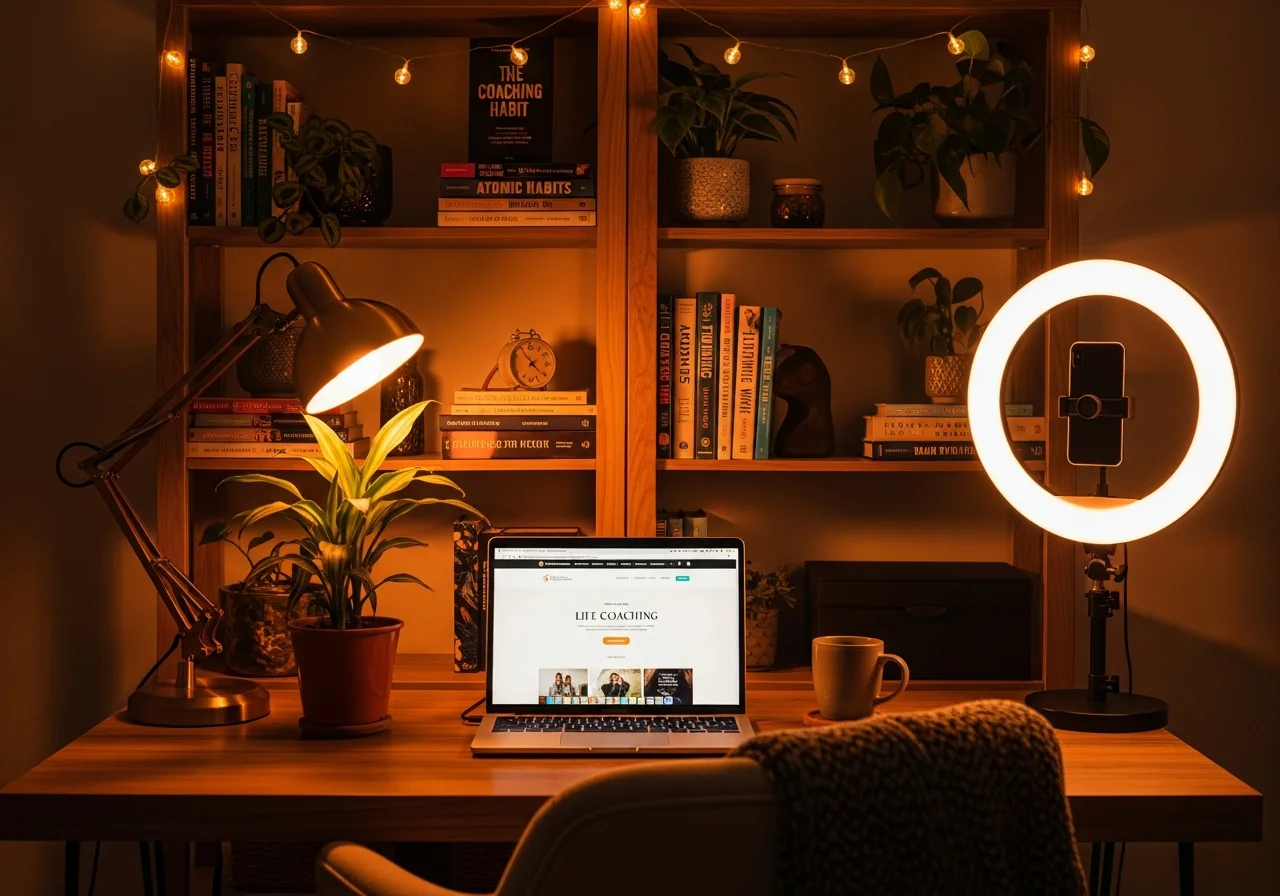
You don't need a lot of space, but you do need a dedicated, quiet area used exclusively for coaching. This matters for professionalism on video calls and qualifies you for the home office tax deduction. Invest in a good webcam, a ring light ($20-$50), a quality microphone ($50-$150), and a clean, professional background. A bookshelf or simple backdrop looks better than a virtual background.
5. Choose Your Tech Stack
Your core tools: Zoom Pro ($13.33/month billed annually) for video sessions, Calendly (free for 1 event type, $12/month for Standard) for scheduling, and Kit (formerly ConvertKit, free for up to 10,000 subscribers) for email marketing. Add a website builder like Squarespace ($16/month) or Wix (free plan available). Total monthly cost: $30-$60. See our online programs page for platform reviews.
6. Set Your Pricing
New coaches typically charge $75-$150 per session, while certified coaches (ACC-level) charge $100-$250 per session (Bonsai, 2026). Packages are more common than hourly billing — a 3-month program at $1,500-$3,000 gives clients a clear commitment and gives you predictable revenue. Calculate your target annual income, divide by realistic coaching hours (ICF reports coaches average 11.6 hours per week), and price accordingly. See our salary guide for detailed benchmarks.
7. Build Your Online Presence
Start with a simple website that has three things: an About page explaining who you help and your credentials, a Services page with your packages and pricing, and a booking page linked to your Calendly. Add a LinkedIn profile optimized for your niche. Organic social media costs nothing and builds trust over time. Don't spend money on paid ads until you've validated your offering organically.
8. Get Your First Clients
Your first clients will come from people who already know and trust you. Tell your entire network you're coaching. Offer 3-5 free or discounted "founding client" sessions to build testimonials and coaching hours. Join local ICF chapters and online coaching communities. Offer a free 20-30 minute discovery call to convert leads — most coaches convert 30-50% of discovery calls into paying clients.
Startup Cost Breakdown: What You'll Actually Spend
One of the biggest advantages of home-based coaching is the low startup cost compared to other professional services. You don't need a lease, equipment, or inventory. Here's a realistic breakdown of what you'll spend.
The budget path gets you to your first paying client for under $2,000 if you choose an affordable certification, use free tools, and build a simple website yourself. The professional path — with a premium certification, paid tools, and professional branding — typically runs $5,000-$8,000.
Either way, you're looking at a fraction of what it costs to start most service businesses. The SBA estimates that most small businesses cost $3,000-$5,000 to start. A home coaching practice can come in at the low end of that range.
Home Coaching Business Startup Costs
| Expense | Budget Option | Professional Option |
|---|---|---|
| Coaching Certification | $500-$2,000 (online, non-ICF) | $3,500-$10,000+ (ICF-accredited) |
| LLC Formation | $35-$132 (state filing only) | $200-$500 (with registered agent) |
| Business Insurance | $190-$350/year (professional liability only) | $500-$1,000/year (GL + professional liability) |
| Website | $0-$17/month (Wix free plan or basic tier) | $16-$36/month (Squarespace Core) |
| Video Platform | $0 (Zoom free, 40-min limit) | $13.33/month (Zoom Pro, billed annually) |
| Scheduling Tool | $0 (Calendly free, 1 event type) | $12/month (Calendly Standard) |
| CRM / Email Marketing | $0 (Kit free, up to 10K subscribers) | $39/month (Kit Creator plan) |
| Marketing / Branding | $0 (organic social media, Canva free) | $200-$500 (logo, headshots, templates) |
Source: Compiled from LLC University, Insurance Canopy, Zoom.us, Calendly.com, Kit.com, Squarespace.com (2025-2026)
Source: Certification + LLC + free tools
Essential Tech Stack for Virtual Coaching
Your tech stack doesn't need to be complicated. The ICF reports that only 47% of coaches use digital platforms beyond basic scheduling and video calls. You don't need fancy coaching software to start — you need reliable tools that work.
Video conferencing: Zoom Pro ($13.33/month) is the industry standard. The free plan works for sessions under 40 minutes, but most coaching sessions run 45-60 minutes, so Pro is worth the upgrade. Zoom Pro gives you 30-hour meeting limits, cloud recording, and AI meeting summaries (Zoom Pricing, 2026). Google Meet is a free alternative if your clients use Google Workspace.
Scheduling: Calendly ($0-$12/month). The free plan includes one event type (enough for a "Book a Discovery Call" link). The $12/month Standard plan adds unlimited event types, reminders, and integrations. Acuity Scheduling ($20/month) is a stronger option if you need built-in payment processing and intake forms (Koalendar comparison, 2026).
Email marketing: Kit, formerly ConvertKit ($0-$39/month). Kit's free plan is remarkably generous — up to 10,000 subscribers, unlimited emails, and landing pages. That's more than enough for a new coaching practice. Mailchimp's free plan caps at 500 contacts, making Kit the better choice for coaches (Email Vendor Selection, 2026).
Website: Squarespace ($16/month) or Wix (free-$17/month). Squarespace has cleaner templates for service businesses. Wix offers a free forever plan if you don't mind their branding on your site. Either way, keep it simple: About page, Services page, booking link, and a blog for SEO. Domain registration is about $12-$20/year (Tech.co, 2026).
Payment processing: Stripe or Square (2.9% + $0.30 per transaction). Both integrate with most scheduling tools. Stripe is more common for recurring subscription billing; Square works well for one-off payments.
Total monthly cost: $30-$60 for the essentials. That's video + scheduling + website. Email and payment processing can start on free plans. Don't buy everything at once — start with the minimum viable tech stack and add tools as your practice grows.
Traditional ICF Programs
- Cost: $3,000–$15,000
- Duration: 6–12 months
- Schedule: Fixed class times
- Location: In-person or scheduled live
Transformation Academy
- Cost: $197
- Duration: Self-paced
- Schedule: Start anytime
- Location: 100% online
Affiliate link · We may earn a commission at no extra cost to you
How to Price Your Home-Based Coaching Services
Pricing is where most new coaches get stuck. The good news: working from home means lower overhead, so you can offer competitive rates while still earning well.
The market range is wide. According to Bonsai (2026), certified life coaches typically charge $75-$200 per session for general coaching, while niche or executive coaches charge $300-$1,000+. The average session fee globally is $244/hour (ICF 2023). New coaches without certification often start at $50-$75 per session.
Sell packages, not hours. Most successful coaches sell packages rather than single sessions. A typical starter package: 12 sessions over 3 months for $1,500-$3,000. This gives clients accountability (they've committed to the process) and gives you predictable income.
Do the math backward. If your target income is $60,000/year and you coach 10 clients at a time with 12-session packages at $2,000 each, you need to close about 30 clients per year (cycling every 3 months). That's 2-3 new clients per month — a realistic target for a home-based practice.
Don't undercharge. Low prices signal low quality. They also make your business unsustainable — remember, as a self-employed coach, you're covering your own taxes (15.3% self-employment tax alone), insurance, and retirement savings. Price at least 20-30% above what you'd need as a salaried employee.
Raise rates as you grow. Start where you're comfortable, then increase by 10-20% annually as you accumulate testimonials, credentials, and results. The life coach salary guide has detailed benchmarks by specialization and experience.
Finding Your First Clients From Home
This is the part that makes or breaks a new coaching business. Certification doesn't bring clients — marketing does. Here's what actually works for home-based coaches.
Start with your personal network. Your first 3-5 clients will almost certainly come from people who already know you. Tell everyone — friends, family, former colleagues, LinkedIn connections — that you're now coaching. Offer a few free or heavily discounted "founding client" spots in exchange for testimonials and feedback.
Offer free discovery calls. A 20-30 minute discovery call lets potential clients experience your coaching style with zero risk. This is the single most effective conversion tool for coaches. Most coaches convert 30-50% of discovery calls into paying clients, according to industry benchmarks.
Build referral relationships. Therapists, HR professionals, financial advisors, and business consultants serve the same audiences you do. Reach out to professionals in adjacent fields and propose mutual referrals. One strong referral partner can fill your entire calendar.
Leverage LinkedIn (especially for B2B coaching). For executive, leadership, and career coaching, LinkedIn is the highest-converting platform. Share insights, engage with your target audience's content, and use your profile as a coaching-focused landing page.
Speak and teach for free. Offer a free 45-minute virtual workshop on a topic in your niche. Use Zoom webinar or a Facebook Live event. Deliver genuine value, then offer coaching to attendees who want to go deeper. This positions you as an expert and generates warm leads.
Be realistic about timelines. Coaches who actively network and market typically land their first paying client within 30-90 days of launching. Building a full-time practice usually takes 12-24 months. Many coaches start part-time while keeping other income — a smart approach that reduces financial pressure.
For more strategies, see our in-depth business startup guide.
Home Office Tax Deductions for Coaches
One of the biggest financial perks of running a coaching business from home is the home office tax deduction. As a self-employed coach, you can deduct a portion of your housing costs from your taxable income.
Who qualifies: You must use a portion of your home regularly and exclusively for business. The space must be your principal place of business or where you regularly meet clients (virtually counts). The IRS requires that the area be used only for coaching — a desk in your bedroom doesn't qualify unless that area is used exclusively for business (IRS Topic 509).
Simplified method: Deduct $5 per square foot of your home office, up to a maximum of 300 square feet. That's a maximum deduction of $1,500 with no receipts or calculations required. Just measure your office, multiply by $5, and report it on Schedule C, Line 30 (IRS Simplified Method).
Actual expense method: Calculate the percentage of your home used for business, then deduct that percentage of your rent/mortgage interest, utilities, insurance, internet, and repairs. This requires Form 8829 and careful record-keeping, but can yield a larger deduction than the simplified method if your office is large or your housing costs are high.
Other deductions home-based coaches can claim:
Business equipment: Computer, webcam, microphone, ring light, and office furniture. Software subscriptions: Zoom, Calendly, website hosting, email marketing tools. Professional development: Continuing education, workshops, and mentor coaching ($100-$300/hour). Business insurance premiums. Professional association dues (ICF membership is $245/year). Marketing costs: Website, domain, business cards, paid advertising.
Self-employment tax reminder: As a self-employed coach, you'll pay 15.3% in self-employment taxes (Social Security + Medicare) on top of your income tax. Set aside 25-30% of your coaching income for taxes. Consider making quarterly estimated tax payments to avoid penalties.
This is general guidance, not tax advice. Consult a CPA or tax professional familiar with self-employment for your specific situation.
Frequently Asked Questions
Sources
Industry-wide data on coaching delivery, revenue, and practitioner demographics
ICF press release on 2025 Global Coaching Study revenue findings
State-by-state LLC formation costs, filing fees, and annual fees
Annual LLC maintenance costs across all 50 states
Professional liability insurance pricing for life coaches
Insurance coverage types and cost ranges for coaching professionals
Complete breakdown of ICF-ACC, PCC, and MCC certification costs
Session rates and package pricing benchmarks for life coaches
Current Zoom Pro and Zoom Workplace pricing
Home office deduction eligibility and calculation methods
Simplified $5/sq ft method for home office deductions
U.S. coaching market size ($16 billion) and practitioner count (232,000+)
Virtual coaching growth projections and market trends
Ready to Launch Your Home Coaching Practice?
Start with the right certification. Compare accredited programs, costs, and timelines to find the path that fits your budget and goals.
Latest Articles

Life Coaching Industry Trends 2026
The coaching industry hit $5.34 billion. Here are the trends shaping 2026 and what they mean for new coaches.

How Much Does Certification Cost?
Complete cost breakdown: ICF-ACC, ICF-PCC, affordable alternatives from $197, and hidden costs nobody mentions.

Can ChatGPT Replace a Life Coach?
AI chatbots vs human coaches: effectiveness, cost, and what the research actually says.

Taylor Rupe
B.A. Psychology | Editor & Researcher
Taylor holds a B.A. in Psychology, giving him a strong foundation in human behavior, motivation, and the science behind personal development. He applies this background to evaluate coaching methodologies, certification standards, and career outcomes — ensuring every article on this site is grounded in evidence rather than industry hype.