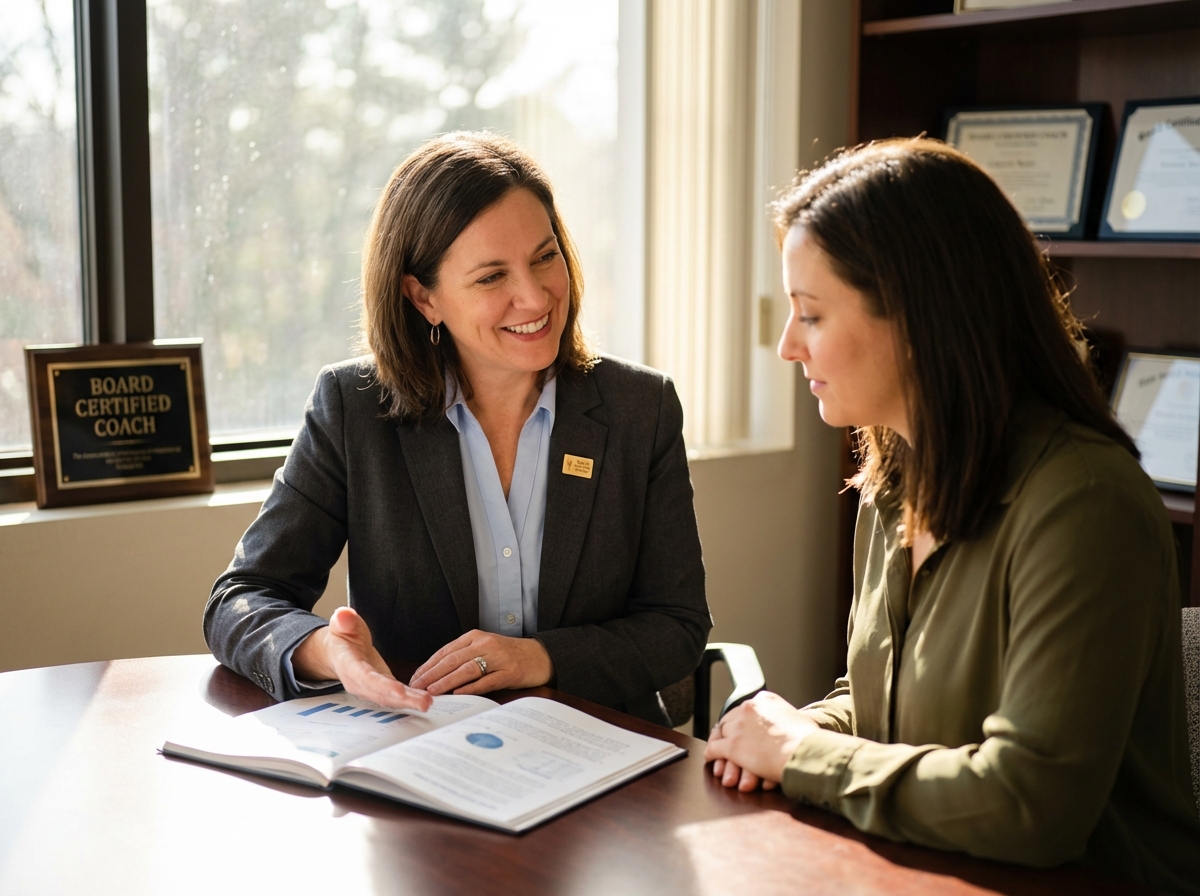
- 1.The CCE-BCC certification (Board Certified Coach) is offered by the Center for Credentialing & Education, an affiliate of the National Board for Certified Counselors (NBCC)
- 2.Multiple pathways exist depending on your degree: bachelor's with 2,500+ coaching hours, or a graduate degree in counseling, behavioral science, or social work with 30-60 hours of coach-specific training
- 3.You must pass the Board Certified Coach Examination (BCCE) and complete 30+ hours of post-degree coaching services
- 4.Maintenance requires 70 hours of continuing education per year and recertification every 5 years

Professional Life Coach Certification
Foundational coaching certification covering methods, tools, and industry best practices.

Life Purpose Coach Certification
Help clients uncover purpose, align actions with values, and create meaningful lives.

Confidence Coach Certification
Help clients develop unshakable self-trust and overcome self-doubt.

NLP Coach Certification
Leverage NLP techniques to reprogram the subconscious for lasting transformation.
Affiliate link · We may earn a commission at no extra cost to you
What Is the BCC Credential?
The Board Certified Coach (BCC) is a credential offered by the Center for Credentialing & Education (CCE), which is an affiliate of the National Board for Certified Counselors (NBCC). It was created specifically to give mental health professionals a structured pathway into coaching.
Unlike the ICF-ACC or other ICF credentials, the BCC doesn't require you to complete an ICF-accredited training program. Instead, it leverages your existing graduate education in counseling, psychology, or social work and adds coach-specific training on top. If you already hold a behavioral science degree or counseling license, the BCC recognizes that foundation and fills in the coaching-specific gaps.
The credential is nationally recognized within the counseling and behavioral health professions. It signals to clients and employers that you have both the therapeutic background and the coaching competencies to work effectively in a coaching capacity.
Who Is the BCC For?
The BCC is most relevant for professionals who already have a background in mental health, counseling, or behavioral science and want to add coaching to their practice. That includes:
- Licensed Professional Counselors (LPCs) who want to offer coaching alongside or instead of therapy
- Licensed Clinical Social Workers (LCSWs) expanding into life coaching, executive coaching, or wellness coaching
- Psychologists adding coaching services to their existing practice
- National Certified Counselors (NCCs) who already hold an NBCC credential and want a natural credential extension
- Marriage and Family Therapists looking to serve clients in a non-clinical coaching framework
If you don't come from a counseling or behavioral health background, the BCC is probably not the right fit. The ICF-ACC is a more widely recognized entry point for coaches without a clinical degree. The BCC's value is specifically in bridging clinical credentials into coaching — it's a niche credential, and that niche is its strength.
Understanding the difference between coaching and therapy is especially important for BCC candidates. The BCC pathway assumes you already know the therapy side and need to learn where coaching diverges in scope, methods, and ethical boundaries.
BCC Requirements by Pathway
CCE offers multiple pathways to the BCC credential, depending on your educational background. All pathways require passing the Board Certified Coach Examination (BCCE) and completing at least 30 hours of post-degree coaching services. Here's how the pathways break down, according to CCE's official requirements:
Pathway 1: Bachelor's Degree
- Hold a bachelor's degree from a regionally accredited institution
- Complete 2,500 hours of coaching experience over a minimum of 5 years
- Complete 30+ hours of post-degree coaching services
- Pass the BCCE exam
This is the most demanding pathway in terms of experience hours. It's designed for people who have been coaching informally or professionally for years and want to formalize their credentials.
Pathway 2: Master's in Counseling or Doctorate in a Behavioral Field
- Hold a master's degree in counseling or a doctoral degree in a behavioral science field from a regionally accredited institution
- Complete 30 hours of coach-specific training from a CCE-approved provider
- Complete 30+ hours of post-degree coaching services
- Pass the BCCE exam
This is the most common pathway for licensed counselors and psychologists. Your graduate education covers the foundational knowledge, and the 30 hours of coach-specific training fills in coaching methodologies, ethics, and competencies that differ from therapy.
Pathway 3: Master of Social Work (MSW)
- Hold a Master of Social Work from a regionally accredited institution
- Complete 60 hours of coach-specific training from a CCE-approved provider
- Complete 30+ hours of post-degree coaching services
- Pass the BCCE exam
Social workers need double the coach-specific training hours (60 vs. 30) compared to counseling or behavioral science degree holders. This reflects the additional gap between social work education and coaching competencies.
Pathway for NCCs and Licensed Counselors: If you already hold a National Certified Counselor (NCC) credential or a state counseling license, you still need coach-specific training to cover the gap between counseling and coaching. The training requirement (30 hours) applies the same as Pathway 2, but your NCC status may streamline other parts of the application.
The Board Certified Coach Examination (BCCE)
All BCC applicants must pass the Board Certified Coach Examination (BCCE). The exam tests your knowledge of coaching competencies, ethics, and practices as defined by CCE.
Key details about the exam:
- The BCCE is a knowledge-based examination covering coaching theory, practice, and ethics
- It is administered by CCE and can be taken at approved testing centers or online
- The exam is separate from any counseling or therapy licensure exams you may have already passed
- Study materials and preparation resources are available through CCE's website
If you've already studied for the ICF Coach Knowledge Assessment or completed an ICF-accredited training program, you'll find some overlap in content. However, the BCCE is distinct and reflects CCE's own competency framework rather than the ICF's core competencies.
Maintenance and Recertification
Maintaining the BCC credential requires a significant ongoing commitment to continuing education:
- 70 hours of continuing education per year — this is substantially more than the ICF's requirement of 40 hours every 3 years
- Recertification every 5 years — you must demonstrate ongoing professional development and active coaching practice
- Continuing education must be relevant to coaching practice and may include workshops, conferences, courses, or supervised coaching
The 70-hour annual CE requirement is notably higher than most other coaching credentials. For context, ICF requires 40 CE hours over a 3-year renewal cycle (roughly 13 hours per year). If you're already maintaining a counseling license that has its own CE requirements, factor in whether BCC hours can overlap with your existing obligations.
BCC vs ICF Credentials: How They Compare
The BCC and ICF credentials serve different populations and carry different weight in different contexts. Here's a direct comparison:
BCC vs ICF-ACC Comparison
| Factor | BCC (CCE) | ICF-ACC |
|---|---|---|
| Credentialing Body | Center for Credentialing & Education (CCE) | International Coaching Federation (ICF) |
| Target Audience | Mental health professionals adding coaching | Anyone pursuing professional coaching |
| Degree Required | Yes (bachelor's minimum, graduate preferred) | No degree required |
| Training Hours | 30-60 hours coach-specific (depends on pathway) | 60+ hours from ICF-accredited program |
| Experience Required | 30+ coaching hours (or 2,500 for bachelor's pathway) | 100+ coaching hours |
| Exam | Board Certified Coach Examination (BCCE) | ICF Coach Knowledge Assessment |
| Renewal Cycle | 5 years / 70 CE hours per year | 3 years / 40 CE hours per cycle |
| Industry Recognition | Strong in counseling/behavioral health fields | Broadly recognized across all coaching markets |
| Corporate Recognition | Limited outside healthcare/counseling | Widely recognized by HR and corporate buyers |
When the BCC makes more sense: You already have a counseling, psychology, or social work degree. Your coaching clients come primarily through referrals from mental health networks. You want a credential that explicitly bridges clinical and coaching work.
When ICF makes more sense: You're targeting corporate clients, executive coaching, or the general coaching market. You don't have a behavioral science degree. You want the most broadly recognized credential across industries and geographies.
Some professionals hold both. If you already have the BCC and want to expand into corporate or executive coaching, adding an ICF-ACC gives you recognition in both worlds. The training hours may partially overlap, though ICF requires training from an ICF-accredited program specifically.
For a broader comparison of all major credentials, see our certifications hub.
Career Impact of the BCC
The BCC's career impact depends heavily on where you practice and who you serve. In the counseling and behavioral health world, the BCC is well-recognized and adds a clear differentiator to your practice. Clients who are referred through EAP programs, therapist networks, or healthcare systems will understand what it represents.
In the broader coaching market — executive coaching, business coaching, career coaching — the ICF credentials carry more weight. Corporate HR departments and coaching buyers typically look for ICF-ACC, ICF-PCC, or ICF-MCC when vetting coaches. The BCC is less likely to be recognized in those contexts.
That said, the BCC fills a real gap. Many licensed counselors and therapists want to offer coaching services but feel uncertain about the ethical and practical boundaries. The BCC training specifically addresses how coaching differs from therapy, how to structure coaching engagements within a clinical practice, and how to market coaching services ethically when you also provide clinical services.
If you're a licensed counselor considering the move into coaching, our guide to becoming a life coach covers the full picture — including how to decide between credentials and build a coaching practice alongside or separate from your clinical work.
Frequently Asked Questions
Sources
BCC credential requirements and application process
Coaching certification impact and industry trends
Taylor Rupe
B.A. Psychology | Editor & Researcher
Taylor holds a B.A. in Psychology, giving him a strong foundation in human behavior, motivation, and the science behind personal development. He applies this background to evaluate coaching methodologies, certification standards, and career outcomes — ensuring every article on this site is grounded in evidence rather than industry hype.