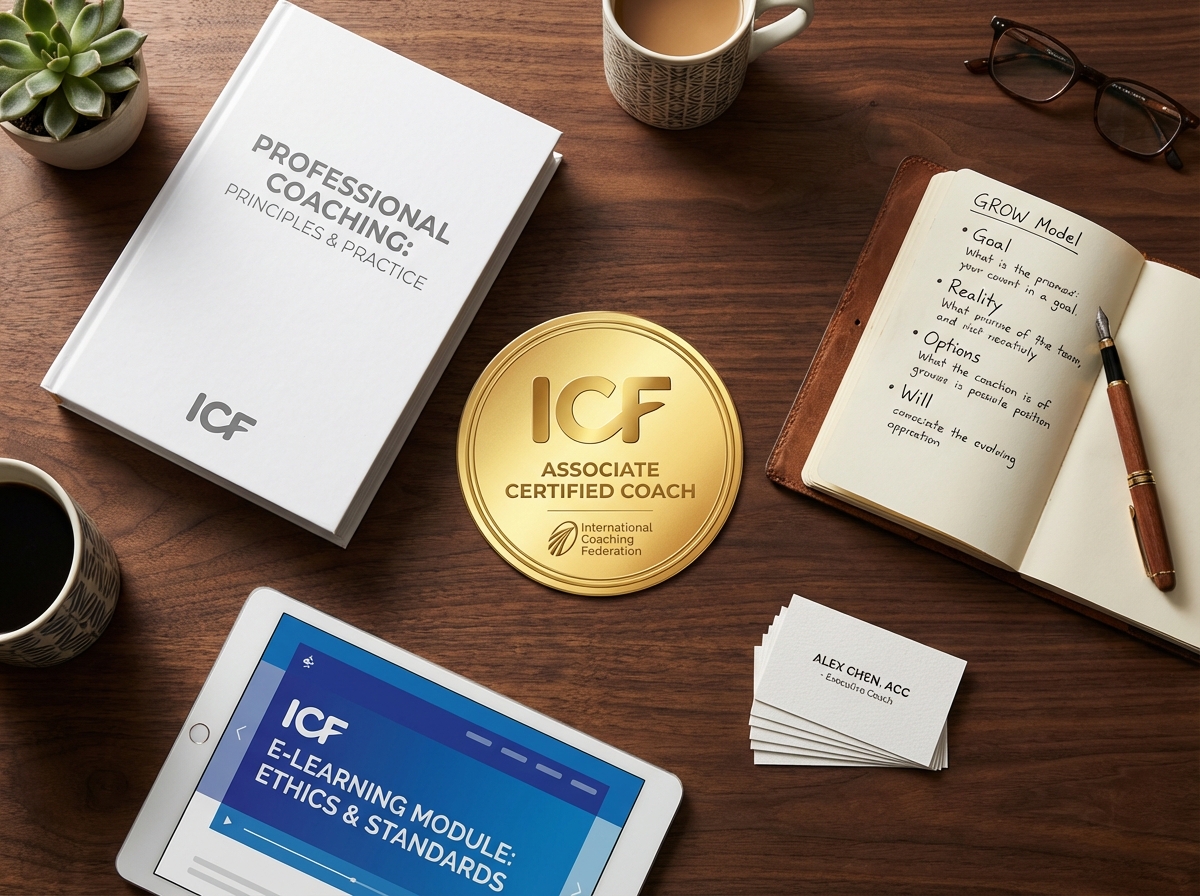
- 1.ICF-ACC certification requires 60+ hours of coach-specific training from an ICF Level 1 accredited program, 100+ coaching hours, 10 hours of mentor coaching, and passing a 60-question exam
- 2.Total investment ranges from $3,400 to $7,300 — training ($2,000-$4,000) is the largest cost, followed by mentor coaching ($1,000-$2,700 if not included in your program)
- 3.The ACC credential must be renewed every 3 years with 40 hours of continuing education and a $175 (members) or $275 (non-members) renewal fee
- 4.Most coaches complete the ACC in 6-12 months, though the timeline depends on how quickly you accumulate your 100 coaching experience hours

Professional Life Coach Certification
Foundational coaching certification covering methods, tools, and industry best practices.

Life Purpose Coach Certification
Help clients uncover purpose, align actions with values, and create meaningful lives.

Confidence Coach Certification
Help clients develop unshakable self-trust and overcome self-doubt.

NLP Coach Certification
Leverage NLP techniques to reprogram the subconscious for lasting transformation.
Affiliate link · We may earn a commission at no extra cost to you
ICF-ACC Requirements (2026)
The Associate Certified Coach (ACC) is the entry-level credential from the International Coaching Federation (ICF). It signals that you've met a recognized standard of training and experience. Here's exactly what you need.
1. Coach-specific training: 60+ hours. You must complete at least 60 hours of coach-specific training from an ICF Level 1 accredited program. This training must cover ICF's core competencies and Code of Ethics. The program must be accredited at the time you complete it — verify accreditation directly on the ICF website before enrolling.
2. Coaching experience: 100+ hours. You need at least 100 hours of coaching experience. Of these, at least 75 must be paid coaching hours. Up to 25 hours can be pro bono. These hours must be accumulated after the start of your coach-specific training. Coaching hours logged before your training began don't count.
3. Mentor coaching: 10 hours. You need 10 hours of mentor coaching — at least 7 hours in a group setting and at least 3 hours of individual (one-on-one) mentoring. This must take place over a minimum of 3 months. Mentor coaching is distinct from your training program; it's a supervised coaching experience where a qualified mentor observes and gives feedback on your actual coaching.
4. ICF ACC Exam. You must pass the ICF ACC Exam, which consists of 60 knowledge-based questions. The exam tests your understanding of the ICF Core Competencies, the ICF Code of Ethics, and coaching methodology. It's administered online and included in your application process.
5. Application and credential fee. Application fees depend on your pathway and membership status: $175 for ICF members, $325 for non-members, or $475 for ICF members using the CCE (Continuing Coach Education) pathway (ICF ACC page).
ICF-ACC Cost Breakdown
The ACC isn't cheap, but the costs are predictable. Here's what you'll spend, broken down by category (Coaching-Online.org).
Training program: $2,000-$4,000. This is the single largest expense. Prices vary by provider, format (online vs. in-person), and what's included. Some programs bundle mentor coaching and exam prep into the tuition; others charge separately. Always check what's included before comparing prices. See our guide to online certification programs for options.
Mentor coaching: $1,000-$2,700. If your training program doesn't include mentor coaching, you'll need to arrange it separately. Group mentor coaching is less expensive than individual sessions. Some mentor coaches offer packages specifically designed for ACC candidates that cover the full 10-hour requirement.
ICF membership: $245/year. Membership is optional but recommended. It reduces your application fee from $325 to $175 — saving you $150 immediately. It also provides access to ICF resources, the coach directory, and continuing education opportunities. Over a 3-year credential cycle, the membership pays for itself in reduced fees alone.
Application fee: $175-$475. ICF members pay $175 (Level 1 pathway) or $475 (CCE pathway). Non-members pay $325 (Level 1 pathway). The Level 1 pathway is the standard route for most new coaches.
Total investment: $3,400-$7,300. The low end assumes an affordable online training program that includes mentor coaching, plus ICF membership. The high end assumes a premium training program, separate mentor coaching, and non-member application fees. Most coaches land somewhere in the $4,000-$5,500 range.
ICF-ACC Cost Summary
| Expense | Cost Range | Notes |
|---|---|---|
| Training program (Level 1) | $2,000-$4,000 | ICF-accredited, 60+ hours |
| Mentor coaching | $1,000-$2,700 | Often included in training; verify before enrolling |
| ICF membership | $245/year | Optional but reduces application fee by $150 |
| Application fee (ICF member) | $175 | Level 1 pathway |
| Application fee (non-member) | $325 | Level 1 pathway |
| Application fee (CCE pathway, member) | $475 | For coaches using CCE continuing education hours |
| Total investment | $3,400-$7,300 | Most coaches spend $4,000-$5,500 |
Realistic Timeline: How Long Does ACC Take?
Most coaches earn their ACC in 6 to 12 months. The timeline depends on three factors: how quickly you complete your training, how fast you accumulate coaching hours, and the 3-month minimum for mentor coaching.
Months 1-3: Complete training. Intensive programs can be completed in 2-3 months. Part-time programs spread across 4-6 months. Self-paced online programs vary depending on your schedule. During this time, you should start coaching practice clients to begin accumulating your 100 hours.
Months 2-6: Accumulate coaching hours. You need 100 hours total, with 75+ paid. If you're coaching 5 clients per week for 1 hour each, that's roughly 20 weeks (5 months) to hit 100 hours. If you're coaching part-time — say 2-3 sessions per week — plan for 8-10 months. Start with pro bono clients early, then transition to paid as your skills develop.
Months 3-6: Complete mentor coaching. The 10-hour mentor coaching requirement must span at least 3 months. Many coaches start this during their training program. If your program includes mentor coaching, this runs concurrently with your other requirements.
Month 6-9: Apply and take the exam. Once you've met all requirements, you submit your ACC application through the ICF portal. The exam is part of the application process. Most candidates who prepare adequately pass on the first attempt.
Fast-track scenario: An intensive training program (2-3 months) plus aggressive client acquisition could get you to ACC in as little as 6 months. Realistic scenario: Training over 4-6 months while building a client base puts most coaches at 9-12 months.
ACC Exam: What to Expect and How to Prepare
The ICF ACC Exam consists of 60 knowledge-based questions. It's designed to assess your understanding of coaching competencies and ethics — not trick you. That said, preparation matters.
What the exam covers. The questions are based on the ICF Core Competencies (updated in 2019) and the ICF Code of Ethics. You'll be tested on concepts like active listening, powerful questioning, creating awareness, establishing trust, and managing coaching agreements. The exam also tests your ability to apply these competencies in realistic coaching scenarios.
How to prepare. Start by thoroughly reviewing the ICF Core Competencies — not just memorizing them, but understanding how they apply in practice. Your training program should have covered these extensively. Review the Code of Ethics, especially boundary situations (when to refer to therapy, confidentiality obligations, conflicts of interest). Practice with scenario-based questions if your program provides them.
Exam format. The exam is administered online. You'll have a set time window to complete all 60 questions. Questions are multiple-choice and scenario-based. There's no penalty for guessing, so answer every question.
Pass rate. ICF does not publicly disclose the pass rate or minimum passing score. However, coaches who complete an accredited training program and study the core competencies generally report passing on the first attempt. If you don't pass, you can retake the exam after a waiting period.
What the ACC Gets You: Career Impact
The ACC won't automatically fill your coaching calendar. But it does three things that matter for building a sustainable practice.
Credibility with corporate clients. If you want to work with organizations — coaching their employees, managers, or executives — the ACC is often a minimum requirement. HR departments and corporate buyers specifically look for ICF-credentialed coaches. Without it, you're unlikely to be considered for corporate coaching contracts.
Higher earning potential. The 2025 ICF Global Coaching Study found that credentialed coaches report higher annual revenue than non-credentialed coaches. The credential doesn't guarantee higher rates, but it gives you leverage when setting fees — especially with clients who understand the difference. See our life coach salary data for detailed earnings breakdowns.
Foundation for advancement. The ACC is step one in ICF's three-tier credential system. After accumulating 500 coaching hours and completing Level 2 training, you can apply for the PCC (Professional Certified Coach). The MCC (Master Certified Coach) follows at 2,500 hours. Each level increases your credibility and earning potential. The ACC gets you on the ladder.
A reality check. The ACC alone won't differentiate you in a crowded market. There are tens of thousands of ACC holders worldwide. What differentiates you is your niche, your results, and your ability to market yourself. The credential opens doors — you still have to walk through them. For a practical guide to building your business, see our complete guide to becoming a life coach.
ACC Renewal: Maintaining Your Credential
The ACC credential is valid for 3 years. To renew, you must complete 40 hours of continuing education (CE) and pay the renewal fee: $175 for ICF members or $275 for non-members (ICF renewal page).
Of the 40 CE hours, at least 24 must be in Core Competency development and at least 3 must be in coaching ethics through an ICF-approved Resource Development provider. The remaining hours can be earned through conferences, workshops, webinars, and other approved activities.
Many coaches use the renewal period as an opportunity to upgrade to PCC rather than simply renewing the ACC. If you've accumulated 500+ coaching hours and completed Level 2 training during your ACC cycle, applying for PCC may make more sense than renewing at the ACC level.
ACC vs PCC: When Should You Upgrade?
The ACC and PCC represent different levels of experience and training. Here's how they compare and when it makes sense to move up.
ACC requirements: 60+ training hours (Level 1), 100+ coaching hours, 10 hours mentor coaching, $175-$325 application fee. Total investment: $3,400-$7,300.
PCC requirements: 125+ training hours (Level 2), 500+ coaching hours, 10 hours mentor coaching, $375-$900 application fee. Total investment: $6,000-$16,800.
When to stay at ACC: If you're still building your practice, working primarily with individual clients, and haven't yet accumulated 500 coaching hours. The ACC is sufficient for most individual coaching practices and many corporate engagements.
When to pursue PCC: If you're coaching full-time, targeting corporate and executive clients, want to charge premium rates ($200-$400+/hour), or plan to train other coaches. Many coaching platforms and corporate directories give preference to PCC and MCC holders.
The practical answer: earn your ACC first, start coaching, build your practice, and upgrade to PCC when you naturally hit the 500-hour threshold. Trying to skip straight to PCC is rarely practical — you need the experience, and the experience takes time.
Browse Coaching Certifications
SponsoredAll certifications $197 · Self-paced · CPD accredited
Professional Life Coach Certification
Foundational coaching certification covering methods, tools, and industry best practices.

Career Coach Certification
Guide professionals through career transitions, branding, and long-term strategies.

Health Coach Certification
Holistic nutrition and exercise principles for long-term client well-being.

Spiritual Life Coach Certification
Help clients build a spiritual foundation, deepen self-awareness, and live with purpose.

Christian Life Coach Certification
Coaching certification integrating biblical principles for spiritual growth.
NLP Coach Certification
Leverage NLP techniques to reprogram the subconscious for lasting transformation.

Grief Coach Certification
Help clients navigate loss with compassion and evidence-based support.

Sobriety Life Coach Certification
Support individuals in creating lasting change and a substance-free lifestyle.
Affiliate link · We may earn a commission at no extra cost to you
Frequently Asked Questions
Sources
Official credential requirements, fees, and renewal policies
Certification impact on income and career outcomes
Professional ethics and standards of practice

Taylor Rupe
B.A. Psychology | Editor & Researcher
Taylor holds a B.A. in Psychology, giving him a strong foundation in human behavior, motivation, and the science behind personal development. He applies this background to evaluate coaching methodologies, certification standards, and career outcomes — ensuring every article on this site is grounded in evidence rather than industry hype.